
Accessory Dwellings
A one-stop source about accessory dwelling units, multigenerational homes, laneway houses, ADUs, granny flats, in-law units…
Mobile Dwellings Unit Survey 2026 (Cully Neighborhood, Portland, Oregon)
This past spring, I conducted the 3rd survey of occupied RVs and Tiny Houses in the Cully neighborhood where I reside. The 1st bike survey was done in spring of 2020, the 2nd one in spring of 2024. This post covers the 3rd and latest Cully bike survey.
Moving forward, I’ll be using the term Mobile Dwelling Unit or “MDU”, to refer to this housing type. Like an “ADU”, an MDU is an accessory dwelling on a residential property. Unlike an ADU, an MDU must be on wheels in order to be fit the “mobile” definition. While there are a lot of unoccupied RVs parked on properties, the term MDU means that the RV/tiny house is hooked up to infrastructure and occupied. You can refer to my prior posts to learn more about the survey methodology.
This latest post also includes preliminary findings from a quantitative MDU survey that we conducted of those residents. This survey was conducted in partnership with Portland State University and Sightline Institute. At the bottom of this post, I’ve linked to the full survey that we used so that others may reuse the survey questions and multiple choice responses elsewhere where this survey is conducted in the future.
The formal results of this MDU survey have not yet been published. But, the bulk of this post includes my preliminary analysis about costs, rental affordability, and household configurations that policymakers can reference as they consider whether and how to allow this housing type.
Starting with the raw numbers of MDUs in Cully, there’s been a substantial increase in MDUs in the last 6 years–roughly doubling in that time frame.
| 2020 | 2024 | 2026 | |
| # of MDUs | 67 | 89 | 120 |
While the numbers of MDUs increased by 22 and 31 between the three bike surveys, the time span between surveys was 4 years and 2 years respectively (i.e., 2020, 2024, 2026). So, when accounting for the time spans between my bike surveys, there’s actually been a substantial rate of increase in MDUs in the last two years.
Drawing broad conclusions from such a limited geographic sample is a stretch, but this is literally the only dataset of its kind due to fact there are no other cities that allow this housing type yet, nor any way to track permits for them.
With that caveat stated, the data indicates that the adoption of this housing type is increasing significantly. I suspected that this was the case, based on increased awareness of Portland’s occupied RV and Tiny House on Wheels regulations. I’ve also been working as a general contractor installing RV hookups for clients since 2021, and that role has given me insights about the market.

This is the album of images of MDUs that were included in the bike survey.

Comparing MDUs to ADUs, there were 72% more ADUs permitted than new MDUs in the Cully neighborhood from 2020-2024, but that trend has flipped entirely between 2024-2026.
From 2024-2026, there were 121% more MDUs installed than ADUs. This graphic is from a Sightline post which provides seven insights gleaned from the Cully bike survey, which you should read.

This animated graphic, also from Sightline’s post, shows the growth of MDUs in Cully.

Preliminary Findings from Cully MDU Survey
As mentioned at the beginning of this post, this time, we also conducted a more formal written survey of the 120 properties, which involved sending mailers and asking a number of mostly multiple choice questions. The goal was to learn and analyze this novel housing form. Here are some of the initial findings.
MDUs are the least expensive market-based infill detached housing available in the US.
MDUs rent for less than ADUs do in the same Cully neighborhood. Notably, the survey finds that the average rent that the MDU occupant pays for a full MDU is $901/month. A small set of recently documented Cully ADU listings shows rents of $1,000–$1,800 monthly, with an average of $1,391/month. Regionwide, average rents for ADUs are $1,541.

Policy makers nationally have rightfully attributed a lot of credit to ADUs as an affordable housing solution, but it is clear from this study that MDUs offer a lower-cost housing option.
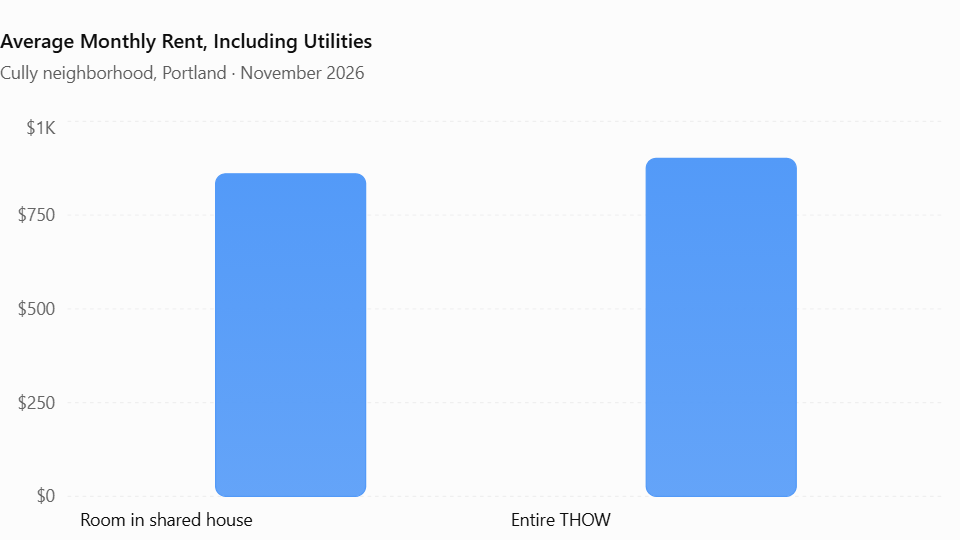
A room within a group house (i.e. a house with housemates) with utilities in the Cully neighborhood rents out for approximately the same amount as a THOW. Room + utilities rents out an average of $860/month, whereas the THOW + utilities rents out at $901/month. The MDU rents for $41 more, but notably, it offers the residents a private bathroom, kitchen and living space.
There’s are a lot of empty bedrooms that could theoretically be rented out today (generating income, and instantly solving the housing crisis), but homeowners nonetheless choose not to rent those spare bedrooms. American culture obviously plays a heavy role here–many Americans want to maintain privacy within our homes, or want to have a spare room for an office or guests. So, when we think about real market-based housing solutions, we have to be mindful of real market dynamics–households generally want to live in their own private dwelling.
And, there is simply no legal, detached housing option that compares in cost to MDUs.
Nothing else is even close, really.
A single-family house with 3BR and 2BA in Cully rents for an average of $2,525.
And the average ADU in the same neighborhood rents out for $1,391.
At $901/month, an MDU rents for 35% less than an ADU, and 64% less than a single-family home in the same neighborhood.
Let’s visually stack up all four of these rental housing options in the Cully neighborhood.

The MDU Pad
Notably, at $607/month, an MDU pad with hookups rents out for significantly less than an MDU itself, or a room+utilities. MDU regulations introduces this entirely novel and very inexpensive tier of housing. It is distinctive in that it does not have any ‘housing’ at all, yet provides the lowest cost housing opportunity possible for renters.

The MDU pad housing framework allows renters to provide their own housing unit- a intriguing deviation from how we generally think about conventional rental housing-akin to a turtle who “lives” in its shell, but “rents” out a patch of prime beachfront to bask in the sun.

This approach removes the landlord from being involved in providing and maintain the dwelling itself, as the dwelling is owned entirely by the MDU tenant. Much as the beachfront property owner is responsible for the land itself, but not responsible for maintaining the quality of the turtle’s shell, the MDU landlord is responsible for the condition of the land and the hookups but not responsible for maintaining the quality of the mobile dwelling. This also means that portions of landlord/tenant laws related to maintaining a structure’s habitility requirements are not applicable; maintaining the turtle shell is the turtle’s responsbility.
The full hookups after 2021 cost an average of $8K to install. This meant that the landlord can recover the cost of installing the hookups in 13 months if they are charging $607/month. This is a very high return on investment for property owners. Of course, $607/month is not life-changing income and they are relinquishing a portion of their yard for the MDU renter. And there’s not an unlimited supply of turtles seeking beachfront.
But, the land costs are already accounted for with the primary dwelling, so the landlord only has to provide a parking spot and hookups to make this housing option available. Building an MDU Pad is vastly simpler and quicker than building a housing unit. Indeed, 85% of property owners completed site preparation and hookup work within four weeks.
| Housing type | Average monthly rent | Sample |
|---|---|---|
| MDU Pad | $607 | 5 |
| Rooms + utilities | $860 | 10 |
| Entire THOW + utilities | $901 | 6 |
| Studio/1BR ADUs | $1,391 | 10 |
| Single-family homes | $2,525 | 15 |
MDU Renters and Affordabilty
16.7% of MDU renters are paying zero for rent- they’re family members or a close family friend (with work trade for utilities).
MDU renters represent an economically vulnerable tier earned between $10,000 and $29,999, 33% AMI — very low income (30–50% AMI).
Mobile dwelling owners who rent MDU pads are concentrated in modest income brackets under $60,000, or 67% AMI — low income (50–80% AMI).
Property owners who rent out MDUs and/or MDU pads spanned the range of low income to high income with no discernable patterns.
How Much do these Mobile Dwellings Cost?
As with ADUs, there’s a huge range of purchase prices for mobile dwellings, ranging from a used travel trailer RV to a high-performance THOW. While this survey is not exhaustive, the median reported price for an MDU was $53,000.
Let me repeat that. $53,000.

As a point of contrast, how much does a bona fide publicly subsidized affordable housing unit in Portland cost to build?
Answer: $500,000.
MDUs are completely market-based housing solution requiring no government subsidies and are supplying housing units that are one-tenth the cost of publicly subsidized affordable housing units.
How much is the average single family house in the Cully neighborhood currently?
Answer: $475,000
“Lower living expenses” was cited by 76% of the respondents as the most common reason they choose to live in an MDU, followed by other motivations including private living space, minimalist lifestyle, environmentally friendly.
Yet MDUs are illegal in every city in this country except Portland. It’s ludicrous.
MDU Landmate Configurations
The flexibile ownership configuration data was also notable.
In 23.5% of the cases, the homeowner owns the mobile dwelling, and the resident rents the dwelling, as well as the piece of land on which it sits.
11.8% of the time, the property owner lives in their MDU and rents out the primary dwelling.
But, 64.7% of MDU dwellers own their own unit. This is the dominant ownership configuration, which entirely flips rental housing on its head.

This arrangement changes the dynamic of the landlord & tenant, as the tenant is fully responsible for providing their own living accommodations, and as “landmates”, they are paying less in (MDU pad) rent as a result.
From the perspective of a renter, however, renting the entire THOW at $901/month appears financially preferable. Mobile dwelling renters avoid having their savings tied up in a movable asset. They also generally avoid repair liabilities, the potentially considerable cost of relocating the unit when a pad arrangement ends, or the need to find a buyer at some point.
Owning the THOW can become more economical over longer periods—especially if the owner buys a used mobile dwelling used, pays cash, and can resell the dwelling. Mobile dwelling owners can preserve or build equity in the dwelling if it retains resale value. Used tiny houses can often be purchased at a good value since many tiny houses are customized for the original buyer. And, many people prefer to own their dwelling for a host of other valid reasons, not least that they don’t have to get permission from the owner to do what they want.
MDU Household Configurations
43% of the MDU and primary household relationships involve family members or preexisting social connections. The remaining 57% involve people who did not previously know the property owner.
All family-based arrangements in this survey were rent-free, showing the ability of MDUs to help families to create infill opportunities on properties that work for a family’s changing needs when the primary house alone becomes insufficient.
Installing RV connections for clients, we see a range of family housing stories. Here’s a few quotes pulled from the survey.
One respondent said, “I was renting and my sister said I should save money over the long term, by buying a tiny home and putting it on her property. So I did!”
Another respondent said that they “wanted a space to house elderly parents when needed”, showing the ability for the MDU to change its use over time.
In another situation, the MDU was housing the widowed daughter of a close friend–chosen family, so to speak. The respondent said,
“I had been vehicle dwelling with my husband in San Diego for about 8 years. He died suddenly, and I returned to Portland to stay with family for a while. I was struggling with grief and could not work reliably. My current landlady was a friend of my father’s and we worked out a work-trade agreement in exchange for renting her RV. I work 33hrs/month on the property landscaping and renovating the various small houses as they come vacant. It has been a mutually beneficial relationship, and has very much helped me get back on my feet.”
A 37 year old small business owner, and Cully MDU survey respondent
Another one explained that she wanted to live “Next to my daughter and son in law to help them with the grandkids and for them to support me — I am a senior citizen”. She concluded, “This is a great living situation to be independent yet live next to my kids and grandkids for social and living support.”
It’s heartwarming to see intergenerational care and support for aging relatives, and affordable independent housing made possible using this simple option–land sharing.
Our company works with many clients who use MDUs as housing in Portland, but who may wish to eventually relocate once the grandchildren have aged beyond elementary school. In fact, it is the majority of our clients. Of four current clients, two of our current clients are using MDUs for grandparents, and a third is providing an MDU for their 20-something year old daughter.
Financing and legal ownership are where multigenerational ADU arrangements can be complicated. The development process is stressful and time consuming. And, add ‘real property’ on a family member’s title, necessarily entangles everyone in the real property impacts- from property tax increases, to how the ADU is valued and assets are redistibuted in the case of a divorce.
If a family member can instead buy and own their housing unit independently, more like they buy a car and park it somewhere, that legal friction and financial tension vanishes. Instead of paying for an attorney to think through unpleasant scenarios at a billable rate of $450/hour, a family can move forward with a clean housing arrangement in which all of their money is applied solely to their actual housing needs. No legal fees. No property tax increases. No building permits. No red tape.

Three Cully properties that responded to the survey hosted multiple MDUs, typically resident-owned tiny houses on rented pads with shared utilities and outdoor space. At one property with three or more MDUs, residents paid $201-$400 a month in pad rent, well under the survey average of $607, and reported dedicated electrical hookups and shared yard space. Residents also listed outdoor space and living near others among their favorite parts of MDU living. This suggests that allowing multiple MDUs per lot could offer affordable, community-oriented land-lease housing. It should be noted that multiple MDUs per lot is not actually allowed. So, there’s still room for regulatory improvement, or maybe I should say, deregulatory improvements—even in Portland.
There is much more analysis to derive from this survey. I will post about this again once I’ve had more time to consider the notable ramifications of this survey, and PSU and Sightline will each publish their own analysis.
Methodology for the Cully MDU Survey
Based on the 2026 bike survey reviewed here, which I conducted with the assistance of Sightline Institute, we cataloged the addresses of 120 properties that had MDUs. These 120 properties were then sent the postcard below. Separate postcards for the property owner and the MDU dweller, were sent.
Recipients were encouraged to fill out the survey, whose URL was included on the postcard. The survey took respondents 20 minutes to complete. The survey spanned the following categories:
- General
- Regulations
- Living Habits
- Site Prep
- Unit Features
- MDU Build/Purchase
- Construction Details
- Current tenants
- Rental Details
- Property Details
- Shared/Outdoor Space
- Rental History
One of the most challenging aspects of this particular survey relates to the flexible configurations of ownership of MDUs. We wanted to hear from both property owners about the installation of RV hookups and other matters, but also from MDU dwellers about their units. As a result, we developed five distinct categories of survey takers, for whom a customized set of questions/responses had to be developed.
- Part A MDU resident who owns the unit, not the land
- Part B MDU resident who rents the unit
- Part C Property owner who owns and rents out the MDU
- Part D Property owner who rents a space for a resident-provided MDU
- Part E Property owner who resides in an MDU on their own land
The full set of survey questions and responses is below. While this full survey shows 65 pages of questions and answers, each survey respondent only answered a portion of these questions.


Share this:

About Kol Peterson

 ADU’s around the web
- L.A. has ADU fever: Accessory dwelling units make up 41% of new housing permits - Yahoo
- Granny Flat Comedy (2023) - IMDb
- Where are all the tiny houses? Staten Island has 40% of citywide accessory dwellings in works - SILive.com
- Hopkinton Weighs New Town Impact Fee on New Homes - Uprise RI
- Accessory dwelling unit workshop set for December 9 - Mooresville Tribune
- Newark Is Offering Home Loans To Build 'Accessory Dwelling Units' - Patch
- Sacramento celebrates first 3D printed Accessory Dwelling Unit - FOX40
- Viroqua Housing Advisory Board plans next steps for tiny homes and accessory dwellings - VernonReporter
- Brush council approves regulations for accessory dwelling units - The Fort Morgan Times
- Walla Walla speeds up permitting for accessory dwelling units - Elkhorn Media Group
- Ocean City to discuss Accessory Dwelling Units - CoastTV
- 5 Things To Know In Mansfield: Storrs Road Drive-Throughs, Accessory Dwelling Rules, School Building Panel - Patch
- ‘I had a wish’: Sacramento celebrates first 3D printed Accessory Dwelling Unit - FOX40
- Belleville looking to hear from residents about detached accessory dwelling units - 91X FM
- Accessory Dwelling Units - Thompson-Nicola Regional District
You must be logged in to post a comment.